From Marie Drouet:
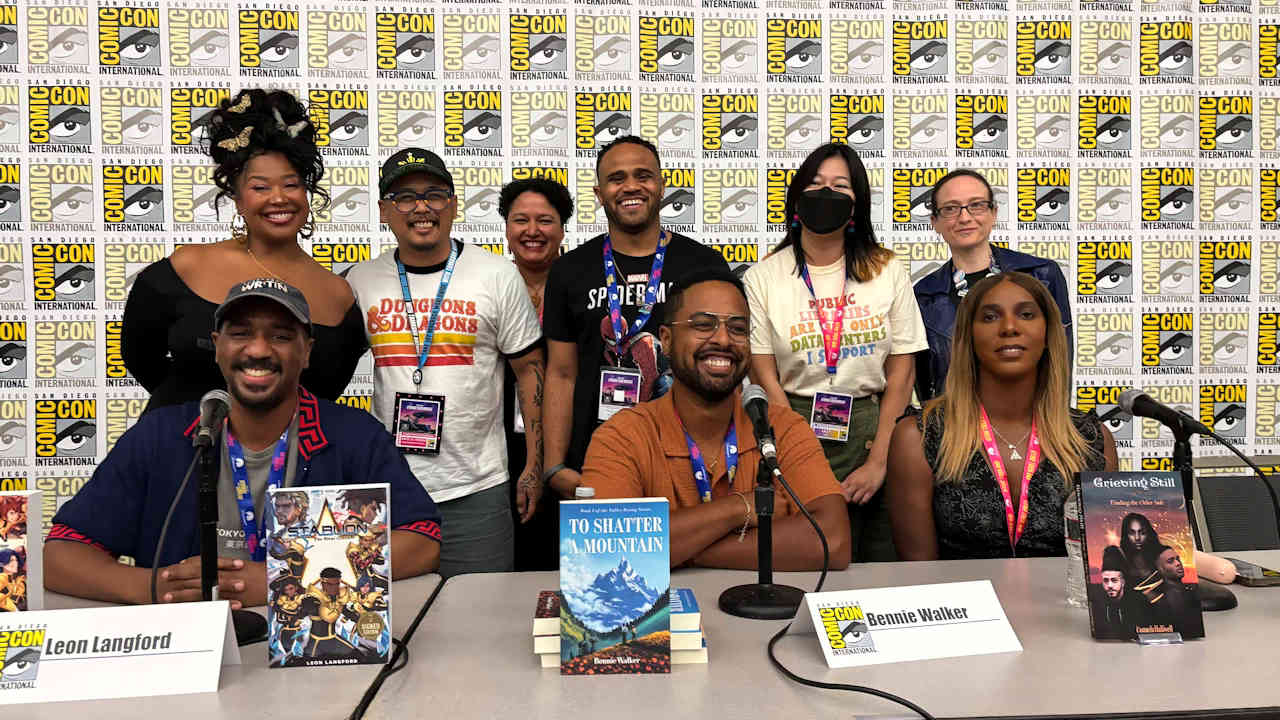
At San Diego’s 2026 ComicCon, Tiffie Starchild, with her dazzling personality and gorgeous coiffure, skillfully lead a distinguished group of authors through an insightful discussion of Diversity in Fantasy and what diverse authors owe their own cultures when writing diverse characters. The panel offered the packed audience equal parts insight, humor, and practical how-to’s, and kept us cheering and finger-snapping in agreement.
Gamers’ Temple is excited to bring you an exclusive interview with the distinguished Diversity in Fantasy Panel followed by a summary of the panel’s discussion.
First, let’s meet the panelists…
Vince Alvendia: comic book artist and illustrator whose current works include Horrorgasm comic anthology and Dark Agents: Violet and the Trial of Trauma.
Lilly Lu: author and literary scholar with a PhD in English whose fiction explores themes such as Asian diaspora experiences, queerness, and the Gothic. Lu’s debut, Death Wish, is out in January 2027.
Kaj Kunstmann: non-binary artist and writer fascinated with telling nuanced stories of the human condition playing out in monstrous and surreal circumstances. Their graphic novel trilogy Warhead won the Silver Medal for the 2026 Independent Publisher Book Award in Graphic Novels and Drawn Books.
Pamuelah Hallilwell: Licensed Marriage and Family Therapist and a Black transgender woman, illustrates characters that represent the diversity in the Black community while also advocating for Black mental health, reducing stigma, community space, and finding our light to shine through the dark. Grieving Still seeks to explore how we as African Americans cope with ongoing fear, mourning, trauma porn, loss and how we try to "Find the Other Side".
Leon Langford: author and award-winning screenwriter from Virginia, best known for writing the young adult superhero book series StarLion and co-writing feature films like Hot Seat. StarLion follows a Black boy in Houston with gravity powers who goes undercover to a school for superheroes.
Bennie Walker: Writer's Digest Award-winning author known for blending science fiction and fantasy elements to highlight the perspectives of Black and marginalized characters. He is recognized for his debut portal fantasy novel, To Shatter a Mountain, which is the first installment in The Valley Rising Series.
Dalila Caryn: fantasy novelist whose Forgotten Sister Series entwines family loyalty and magic, and The Battle for the Sky where “there is no such thing as love”: will the sisters be strong enough to abandon their lifelong battle and embrace what they truly deserve?
John Wells III: the award-winning author of The Last Angel Warrior and The Heir of Ambrose of The Kalib Andrews Chronicles. Since graduating college with his Bachelor of Arts degree in Theatre Performance, he has worked in live theatre, public speaking, and education.
Moderated by Tiffie Starchild: digital creator, host, writer, model, and actress whose work centers on nerd culture, fandom, and lifestyle content.
[All comments have been edited for length and clarity without altering their original meaning.]
GT:
Let’s first check our assumptions, what does “diversity in fantasy” mean to you?
The Panel:
Diverse characters are real people. They are complex, non-white characters that represent marginalized experiences outside of the contemporary norms. They are not tropes or tokens, but have flaws and strengths and growth arcs of their own.
Minorities are seldom the heroes of the story, and neurodivergence and abilism are often overlooked entirely. When writers leave “saving the gang” to the one white character, like in the recent adaptation of the Power Rangers, that’s performative. It’s hierarchy of class and it’s not appropriate diverse representation.
GT:
How has the traditional story norm impacted our fantasy stories and how can authors change this?
The Panel:
Fantasy has historically been Eurocentric, where we always tell a backstory of European castles and monarchy. And personally, that feels like telling other peoples’ perspectives, other’s views, other’s mythologies.
Fantasy novels have also historically been Orientalists and have hinged on this idea of “us versus them.” The “in-group” versus “the other.” So, we want to see more fantasy that breaks that binary between us versus them.
Also, they [Eurocentric story tellers] are always free to insert themselves into our stories, but the minute we insert ourselves into their stories, it's unrealistic. For example, there's no Black Norse god, but everybody's fine with a white samurai. So, by bringing in more diversity, we’re taking back our spaces.
We can also bring diversity into exiting projects by seeing how we can mold them to make space for everybody; by centering on experiences that aren't the boilerplate that the old white men are accustomed to. A really good example of that is Hannibal. The original is all straight white men. But consider the TV adaptation of Hannibal, they did a really good job of diversifying the characters and making it interesting. We're not there yet, but they did a lot of work to make it almost a completely different animal. And that is diversity as well.
GT:
Let’s discuss character development: how do writers get it right and how do they get it wrong? What are the pitfalls in the development of diverse characters?
The Panel:
You start with the character instead of putting their race at the front. Every character is human. Focus on that. Bring fully developed characters to the story. If you start with the race, then you’ll create a caricature, not a human.
Research. Know your characters. What are their backstories, their motivation, strengths, weaknesses, fears. Research their culture, their foods, their mannerisms. Start with building the character as a person. For example: How would that individual respond to a small or large threat? With humor, violence, passivity, eye-for-an-eye? Build your character’s individual personality and mannerisms.
GT:
And that’s a great segue into culture. What is your advice for how to get the cultural development right without falling into a trope. In the fantasy genre, with made up worlds and cultures, where's the line in combining the imaginary with the real, while holding true to the group they represent?
The Panel:
For me, it's always nuanced; finding the nuance of a culture. Like food or language, they’re different in every culture, yet so specific. So, taking tidbits of reality and adding it to your characters, adding it to your story, really makes it stand out. Diversity is more than just having your character say a couple Spanish words. Doing that cultural research also make your stories that much richer.
Don’t just read a book on the race, reach beyond the pages. What you need to do is spend time with various people in that culture because you need to be exposed to it. When the author doesn’t take the time to actually understand that community and that culture, the character becomes flat, just a “white person painted some color”.
GT:
Any marketing tips for bringing stories with diverse characters out to audiences? Do you feel pressure to whitewash the marketing? Is there a balance?
The Panel:
The more niche your product is, the easier it is to actually find your audience. If you water it down for broad appeal, it's not actually going to be a good project. If you lean into how weird and unique your story, your characters, your world is, you're going to find your audience. Lean into the weird and embrace what makes it unique. Don't try to water it down. Don't try to make it generic.
It’s easy to be fake in marketing, but people see through that. What really works is to be authentic. Show up as yourself. Call out your genre, call it your own, speak to the other weirdos that are like you. Actually talk with people. Literally, just be yourself. That's what sells. Be creative, find your pitch and get your work out there. Give your audience a chance to find you.
And support your fellow creatives. Enlarging the pie helps attract new fans to the party, and then everyone wins. Your audience wants to find you and they want to share their experiences with their community. Let’s make that community larger for us all.
The ComicCon Diversity in Fantasy Panel Discussion
Starchild to Vince Alvendia: Being born in the Philippines has helped you identify a trauma plaguing America today: the growing pushback against diversity in the world of fantasy books, films, and graphic novels. By appearing on Diversity panels like this, you've made your mission to help reverse that trauma. What would need to happen in the USA for you to walk away and declare your mission finished, if not perfect.
Alvendia: The ideal answer is that there is equal representation of everybody's stories. What is not perfect about that, as we've seen in the recent times, is that it can become unfinished and we have that struggle again. We’re making strides, but it just took one presidency for people to show their true colors, hiding in plane site. It [is awful] to be that way, but until we move towards that Star Trek future I was promised as a child, it’s just the way it has to be.
Starchild to Lilly Lu: What are the dangerous 18th century beliefs about queerness and rage still lurking in the shadows that are keeping us from moving on, especially in relation to the Asian diaspora?
Lu: So as one who studies 18th century British literature, I am often reading things that I do not agree with, but in fact disgust me. We're still living with the ripple effects of the philosophies and ideologies that come to being in the 18th century. One of my favorite scholars, Andrew Said, coined the term Orientalism. The idea of the East, in different historical periods, has encompassed different people's cultures, things, ways of being. For example, the Irish were seen as oriental for a very long time. The same tropes that were used against them, such as they are “savages” or don't have the “right religion”; all of those tropes are repeatedly applied to different oppressed peoples at different points of history as a way to justify the Imperial Project. A lot of our struggles are shared. But the ways in which it affects Asian women specifically is that we are all abstracted into objects.
Starchild to Kaj Kunstmann: You are a proudly queer, multiple award-winning graphic novelists who's been making comics since 2013. You have a passion for creating stories that explore the human experience. As you strive to achieve recognition in your artistic career, what are some of the surreal experiences you’ve endured involving race, queerness, and diversity that have made your own head want to explode, and what type of therapy do you recommend for the people standing in your way?
Kunstmann: The myth of meritocracy. We're told constantly that if we're just a certain way, if we're good enough, if we write or draw well enough, we can achieve our dreams or get past the bar, we can make it. And it’s all a lie. It's capitalism, it’s patriarchy, and it’s racism. Also, in the same box as meritocracy, the idea that everyone on this panel, what they bring to the table is only defined by what makes them different, and not their actual own excellence. Most of the people on this panel probably won't get invited to other panels because they're not all white men. And I have a lot of old white men writers that I love very deeply. They're friends of mine, but they're on multiple panels because they can network better. They're allowed in rooms that we're not allowed in. And we’re just not ever given that opportunity, no matter how it would be right, no matter how well we draw, no matter how well we act. And so, meritocracy is a lie.
As far as therapy, EMDR, that will change your life. Also, cognitive behavioral therapy and neural therapy. You're responsible for handling your personal drama, your behavior. And so anyone who stands in my way, they need to go handle that and lock it down.
Starchild to Pamuelah Hallilwell: What ways can we demonstrate courage, compassion, and justice to facilitate healing for the hurt souls of the Black and transgender communities? How can we show up?
Hallilwell: My first thought has to be the healing. Healing really begins when people feel fully seen, not judged, not debated, not accepted for parts of who they are or who you like them to be, but who they fully are.
When I think of courage, compassion, and justice, these are not just ideals. These are actions. Courage to me looks like standing beside the communities that are most marginalized or most impacted. Courage is being with them when you are really not comfortable. Not just when it's convenient.
Compassion is being curious. Looking beyond people versus a label, and getting to know people and who they are. Building those connections and those relationships.
Justice is often looking inward. Examining your own biases and privileges, because we all have biases, and it's okay. Learn what they are and use them to empower other people.
We need to choose courage, compassion, and justice every day. When readers see characters who look like them, who are shown with dignity, readers feel like they belong. When readers connect with a character that they wouldn't personally know, we create humanity. We create the ability for other people to build empathy and an understanding of different walks of life, and that's what I think is necessary and needed now more than ever.
Starchild to Leon Langford: In StarLion you flipped the usual narrative to show that no matter your race, age, or background, anyone can be a hero. What events in your life prompted you to make your mission to inspire the marginalized to see themselves as heroes in their own story?
Langford: I feel like when I was growing up, I was the only Black kid in the manga section; the only Black kid in the anime club. And I always found that all the characters of color were just on the side. They were the supporting characters and that frustrated me so much. That because of the color of their skin, they were often pushed to the side or just marginalized. When Barack Obama was running for president, he said he didn't want to be “the Black” candidate. He just wanted to be “The” candidate. So, with my characters, I represent them first not as “the Black character” or “Latino character”. They're just that character, that person. Fully develop the character first. Oftentimes, I think we look at race too much in the foreground, and I think most of the time, when you look at race as more of a background thing to influence their culture, their spaces, their spirit choices, it makes a much stronger character.
I try to write my characters in a way where they feel real, if you're authentic, and oftentimes, I want to make sure those characters that used to be on the margins are on the front cover. And so that's my initial start line is to make sure the kids and people in the audience see themselves on the front cover.
Starchild to Bennie Walker: Two of your characters are forced into a volatile partnership, and despite being a terrible match, they have to rely on one another just to stay alive. What lessons can you share about making interracial partnerships work? Not only in marriage, but in business, in media, and entertainment, and publishing, in a world system that may not see your product as having equal value.
Walker: I think the biggest problem we have nowadays is communicating and not seeing each other where we're at; not living in each other's spaces. That was the challenge of writing To Shatter a Mountain: the idea that we need to really communicate on a level that we can all understand. Certain people need more space, so give them that space to communicate their worries, their problems. Personally, in almost all situations, I'm the only Black person or person of color, so I work to change people's minds through example. So much of what we deal with nowadays are people stuck in their ways, that I think the best way to kind of get them to change their mind is to not combat them, but to meet them with compassion and love.
Starchild to Dalila Caryn: What are some of the battles you see involving race and gender that keep us mired in resentment? What beliefs have been passed down and have created a destructive legacy, preventing us from embracing what we truly deserve?
Caryn: That’s a big question, but honestly, one of the questions I try to answer in The Battle for the Sky. The biggest thing that we passed down through colonialism, through patriarchy, through a lot of the destructive forces that are surrounding us on a daily basis, is the idea that we are in competition with each other rather than in community with each other. So, these sisters are forced to confront the fact that they just spent their whole lives competing for the love of one person who was never going to give it to them when, if they embraced each other, they could get that kind of love.
When we build a community and build more opportunities to support each other, the more people in our community, the bigger the room grows. More and more people want to see these works, but they are not being presented with them, so we need to be a community.
Starchild to John Wells III: Whether your stories are fantasy or contemporary drama, they often explore the tension between who society tells us we are and who we ultimately choose to become. Why has that become such a defining theme in your work? And what do you hope people from every background take home from those journeys?
Wells: I didn't realize that that was such a theme in my writing until later, when it was pointed out to me. I realized that has a lot to do with my background. I'm a queer Black son of a pastor, so I've been told my entire life who I'm supposed to be. I'm told what’s right, what's wrong, and in essence that I'm wrong. So, I realize the importance to me of writing about identity. The characters that I have are in a system that is telling them who they're supposed to be. Even in my new series, Eri and the Gods [in development], where a kid finds out that he's a monster in a world where the gods have decided that monsters need to be exterminated.
In this world, there are lot of constructs that have been put onto different groups telling you who you are supposed to be. And one of the questions that I address in all of my stories is who gets to decide that, and when do you take the wheel and take control of that narrative? So, what I want people to take away is that you have control over your own narrative. That you get to drive and create your own story. You need to write your own story and be whoever it is that you want to be, regardless of the construct that exists out there.
Audience Question: How do you write a story with diverse set of characters, celebrate that diversity and also still make them flawed?
Panel: Tie their flaw into their character arch. How do they change: who are they at the beginning of the story, what changes them in the middle, and who are they at the end. Celebrate those differences and use them to move the plot. It comes back to making the human first. Make fully developed, relatable characters, including flaws and focus on the humanity first.
Also, make the characters nuanced. We don’t live in a cookie-cutter world. Things have always been shades of gray. Support a multiplicity of stories and voices. Don’t try to represent all minority traits in one monolith.
Audience Question: How do you write a character that is not attached to representing everybody in that marginalized group, while balancing the responsibility to that community.
Panel: There are certain extremes when it comes to portraying characters. For example, there can be extremes in the spectrum of portraying race identity and where your character lives on that spectrum. There's no monolith. Decide what pop of that culture does your character get? Are they more of the extremists or are they more of the pacifist? Or are they a combination?
Once I realize where a character sits in a certain story beat or a certain characterization, I'm a lot more comfortable writing them. If I know the different ways that they're going to communicate (for example), then I can lean into that aspect of their personality to drive the story.
Putting the pressure on yourself to make a character represent all facets of a community is incredibly dangerous and tough to write in a way that respects the pool. There is no physical person that represents the entire community. What we can do is encourage people to continue to explore other aspects of being and other ways of existing; to feel connected and inspired to write stories in new ways, instead of just utilizing characters that fit certain tropes, or certain identities, or certain ways of being.